Why Do I Feel Tired All the Time Even After Sleeping? (Real Causes)
why do i feel tired all the time even after sleeping? Discover the real causes behind constant fatigue, from sleep quality to nutrients and metabolism, and what may be affecting your energy daily.
ENERGY & VITALITY
1/20/20266 min read
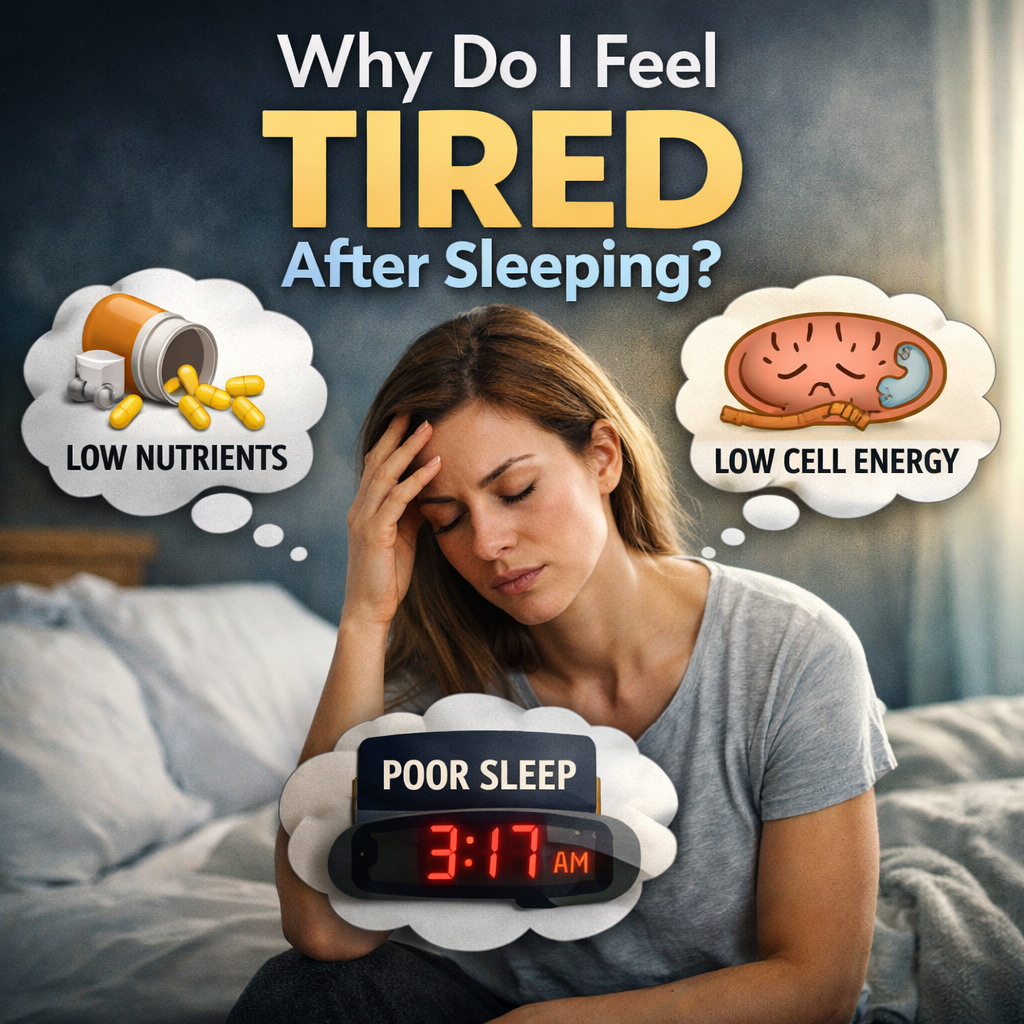
You wake up, open your eyes… and for a moment, everything feels normal.
But then it hits.
Your body feels heavy.
Your mind struggles to focus.
And somehow, even after a full night of sleep… you still feel tired.
If you’ve been asking yourself why do I feel tired all the time even after sleeping, you’re not alone, and more importantly, this is not something you should ignore.
Because in many cases, the problem isn’t how long you sleep.
It’s how your body produces energy.
Why Do I Feel Tired All the Time Even After Sleeping?
What You'll Learn
In this article you'll discover:
Why sleep alone doesn’t always restore energy
The most common hidden causes of constant fatigue
How metabolism and nutrients impact your energy levels
Why fatigue often becomes more noticeable later in life
What patterns may be quietly draining your energy every day
The Real Reason You Still Feel Tired
Feeling tired after sleeping is often not a sleep problem, it’s an energy production problem.
Most people assume: “I’m tired → I need more sleep”
But the body doesn’t work that way. Sleep is just one piece of the equation.
Even if you sleep 7–8 hours, you can still feel exhausted if:
your sleep cycles are shallow
your metabolism is inefficient
your body lacks key nutrients
Hormonal balance
Daily biological rhythms
Energy depends on:
how your cells produce it
how your body uses nutrients
how your internal rhythms are functioning
If any of these are off, sleep alone won’t fix it.
Many people assume that sleeping longer automatically means better recovery.
But the truth is: Sleep duration and sleep quality are not the same, and quality is what determines your energy.
Your body doesn’t measure sleep in hours. It measures it in cycles and depth.
A full night of restorative sleep is made of cycles that include:
Light sleep → transition phase
Deep sleep (slow-wave sleep) → physical recovery
REM sleep → brain restoration and memory processing
Each stage plays a different role.
Deep Sleep: Where Real Recovery Happens
Deep sleep is the most critical phase for physical energy.
During this stage:
Muscle repair and tissue recovery occur
Growth hormone is released
The body restores physical energy reserves
If deep sleep is reduced, your body may:
wake up feeling heavy
feel physically drained
struggle with endurance during the day
REM Sleep: Mental Reset and Clarity
REM sleep supports:
cognitive function
emotional balance
mental clarity
When REM is disrupted, you may feel:
mentally foggy
unfocused
slow to think
You can sleep 8 hours but still feel exhausted if your sleep cycles are fragmented.
What Disrupts Sleep Quality (Even If You Sleep Long Enough)
Many subtle factors reduce sleep quality without you noticing:
Frequent micro-awakenings
Stress and elevated cortisol
Irregular sleep schedules
Late-night screen exposure
Poor nutrient status (like magnesium deficiency)
These don’t always wake you up fully, but they prevent deep, restorative sleep.
🧩 Why This Creates “Invisible Fatigue”
This leads to a specific pattern:
You don’t feel “sleepy”
But you feel physically drained
Energy never fully restores
If your body doesn’t reach deep recovery stages, it starts the next day already depleted.
How to Recognize a Sleep Quality Problem
You may not notice poor sleep directly — but your body shows signs:
You wake up tired even after enough hours
You feel worse in the morning than at night
You rely heavily on caffeine to function
Your energy improves late in the day
These are often signs that sleep depth, not duration, is the issue.
2. Mental Fatigue Is Real (And Often Ignored)
One of the most underestimated causes of fatigue is mental overload.
And it’s very different from physical tiredness.
Your brain can be exhausted even when your body is physically rested.
Why the Brain Drains So Much Energy
Even at rest, your brain consumes a large portion of your body’s energy.
Now consider modern daily life:
constant notifications
decision-making
multitasking
information overload
Your brain is almost never “off”.
What Is Cognitive Load?
Cognitive load is the amount of mental effort your brain is handling.
When it stays high for long periods:
your brain consumes more energy
your nervous system stays activated
recovery becomes incomplete
Real-life example:
You spend the entire day:
working
solving problems
checking messages
switching between tasks
At the end of the day, you didn’t move much…
But you feel completely drained.
Mental effort accumulates, and your brain doesn’t recover instantly when you sleep.
Why Sleep Alone Doesn’t Fix Mental Fatigue
Sleep helps, but it may not be enough when:
your brain never disconnects during the day
stress remains high
your mind stays stimulated until bedtime
This creates a loop:
High mental load during the day
Poor mental recovery at night
Reduced energy the next day
The “Always On” State
Many people live in a constant state of:
alertness
stimulation
low-level stress
This keeps the nervous system activated.
And over time, it leads to:
persistent fatigue
low motivation
difficulty focusing
Fatigue is not always about doing too much physically, it’s often about never truly stopping mentally.
How Mental Fatigue Feels (Different from Sleepiness)
Mental fatigue has a distinct pattern:
You’re not sleepy, just drained
Tasks feel heavier than they should
Motivation drops
Focus becomes difficult
Signs That Mental Fatigue Is Affecting You
You feel tired even on low-activity days
You struggle to concentrate
You feel overwhelmed by simple tasks
You don’t feel mentally refreshed after sleep
Why This Matters for Energy
Your brain is a central regulator of energy perception.
If your brain is fatigued: your body will feel fatigued, even if physically rested.
Mental fatigue changes how your body perceives energy, making you feel tired even when your body has recovered physically.
3. Your Cells May Not Be Producing Enough Energy
Energy is created inside your cells, specifically in the mitochondria.
When this system slows down, you may feel:
Constant fatigue
Low stamina
Difficulty starting tasks
You don’t “have” energy, your body must continuously produce it.
4. Hidden Nutrient Deficiencies
This is one of the most underestimated causes.
Let’s go deeper:
Vitamin B12
Essential for nerve function
Helps convert food into energy
Supports red blood cell production
Low levels can lead to:
fatigue
weakness
mental fog
Magnesium
Involved in 300+ biochemical reactions
Critical for muscle and nerve function
Supports energy production at cellular level
Low magnesium can cause:
tiredness
poor sleep quality
low resilience to stress
Iron
Responsible for oxygen transport
Directly linked to energy levels
Low iron = less oxygen → less energy
Even mild deficiencies can reduce your energy long before severe symptoms appear.
Why This Happens More As We Get Older
This is a crucial (and often ignored) factor.
As we get older, several changes happen:
1. Nutrient Absorption Declines
Your body becomes less efficient at absorbing:
B12
magnesium
other micronutrients
2. Mitochondrial Efficiency Decreases
Cells become less efficient at producing energy.
3. Recovery Takes Longer
The body doesn’t “bounce back” as quickly as before.
Fatigue later in life is often not caused by one issue, but by multiple small inefficiencies adding up.
5. Your Daily Rhythm May Be Working Against You
Your circadian rhythm controls:
sleep
hormone release
energy levels
When disrupted, you may feel:
tired in the morning
low energy in the afternoon
inconsistent throughout the day
A Combination of Factors (Not Just One)
Research published in Sleep Medicine Reviews shows that fatigue is often multifactorial.
Meaning:
👉 It’s not just sleep
👉 It’s not just diet
👉 It’s not just stress
It’s the combination.
The more factors involved, the harder it is to fix fatigue by changing only one thing.
Many people today choose to complement their diet when intake may not be sufficient. If you choose to explore supplementation, we suggest options known for their quality and consistency:
Iron: Iron 18 mg Gummies with Vitamin C
Magnesium: High Absorption Magnesium Glycinate
B12: B12 1000 mcg Softgels
Multivitamin: Multi + Ginseng Capsules
A Practical Way to Start Regaining Energy
Instead of guessing, start observing patterns:
Ask yourself:
When do I feel most tired?
Is it after eating?
In the afternoon?
Right after waking up?
Example patterns:
Afternoon crash → possible rhythm/nutrition issue
Morning fatigue → possible sleep quality issue
Constant fatigue → likely metabolic/nutrient related
Continue Exploring (Loop Estratégico)
To go deeper into this topic:
FAQ
Why am I still tired after 8 hours of sleep?
Because energy depends on more than sleep, including metabolism, nutrients, and stress levels.
Can vitamin deficiencies cause constant fatigue?
Yes. Even mild deficiencies in B12, magnesium, and iron can reduce energy significantly.
What is the most common cause of feeling tired all the time?
Usually a combination of poor sleep quality, stress, and low cellular energy production.
Topical Reinforcement Paragraph
Feeling tired all the time, even after sleeping, is often a signal that your body’s internal energy systems need attention. By understanding how sleep, nutrients, metabolism, and daily rhythms interact, it becomes easier to identify patterns and gradually restore consistent energy over time.
References
The information presented in this article is based on peer-reviewed research and scientific publications.
Sleep Medicine Reviews
National Institutes of Health (NIH)
Harvard Health Publishing
Disclaimer
This content is for informational purposes only and does not constitute medical advice.
Affiliate Disclosure
This article may contain affiliate references. When products are mentioned, we prioritize trusted and widely recognized brands.
Editorial Policy
All content is based on scientific evidence and reviewed for clarity and accuracy.
Someone you care about might need to hear this, share it with them.
Want to keep learning?
Subscribe to receive weekly content about strength, independence, well-being, and longevity.
Contact
Send your testimonial or contact us
info@masteractive.life
© 2026. All rights reserved.
About Our Project:
Editorial Policy
Medical Disclaimer
Affiliate Disclosure